When Carnegie Museum of Art reached out to 3D Print Pittsburgh in Spring 2025, they presented a unique challenge: create custom display mounts for delicate antique hand fans that would be featured in an upcoming exhibition. This project would demand precision, patience, and a deep respect for preserving cultural artifacts.
The Challenge
The museum’s preservation team, led by William Bergmann and Associate Preparator James Nestor, needed mounts that would:
- Provide stable support for fragile antique fans
- Make minimal contact with the artifacts to prevent damage
- Match the complex topography of each fan’s surface
- Include integrated mounting hardware for exhibition display
- Accept professional finishing to meet exhibition standards
These were not off-the-shelf brackets – each mount needed to be a one-of-a-kind piece engineered specifically for its fan.
3D Scanning: Capturing the Impossible
The first challenge was capturing the exact surface geometry of each fan – specifically, the underside that the mount would cradle. But how do you scan the bottom of a delicate artifact that cannot be flipped over or handled excessively?
Working with the museum’s conservator, we developed a creative solution: suspending a sheet of clear plexiglass between two tables, creating a transparent platform for the fan to rest on.
The conservator gently placed the fan on the suspended plexiglass, giving us full access to the underside while the artifact rested safely on a flat, stable surface.
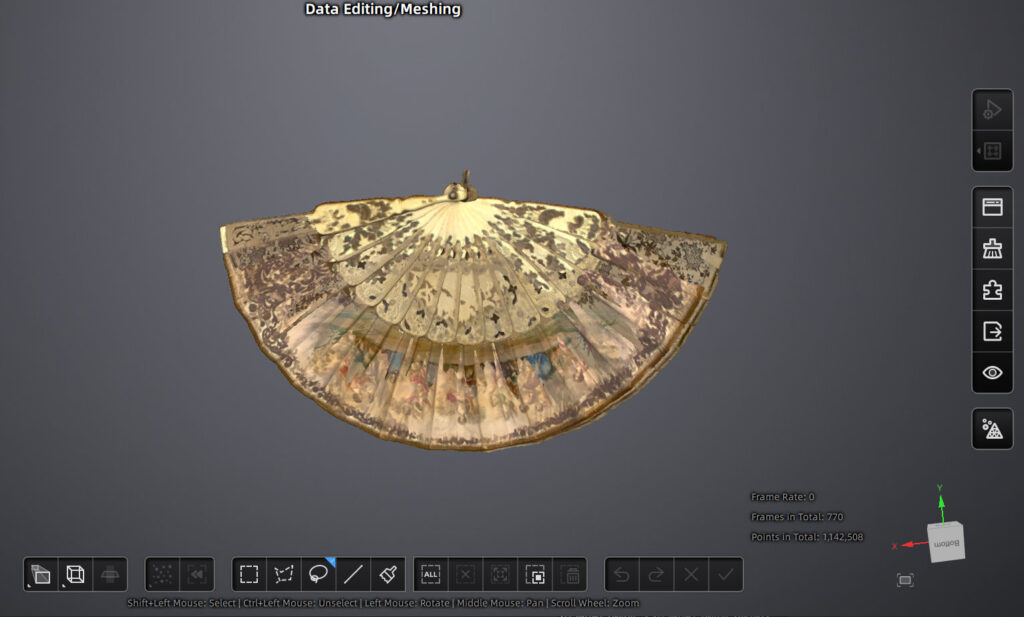
Using our Einstar 3D scanner, we were able to capture the intricate surface detail from below. The scanner’s infrared structured light passed right through the clear plexiglass without obstruction, capturing every contour of the fan’s resting surface – the wooden sticks, the fabric folds, the subtle variations in height.
The result was a detailed point cloud that we converted to an STL mesh – a precise digital replica of the surface our mount would need to match.
From Scan to Mount: 3D Modeling in Blender
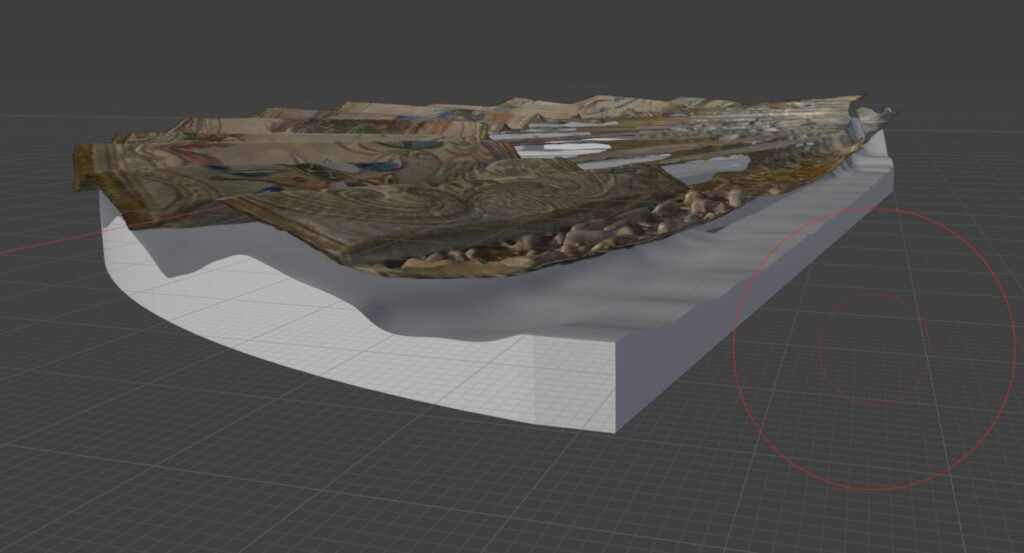
With our captured scan data as a foundation, we imported the STL into Blender and began the precision modeling work:
- Shrinkwrap modifier to conform the mount surface to the scan’s exact contours
- Subdivision and smoothing to create a gentle, artifact-safe contact surface
- Minimal material philosophy – supporting only what was absolutely necessary
- Integrated mounting posts recessed to accept #4 cap head screws without interfering with the fans
This was not a quick process. Each mount went through multiple design iterations, with the museum team providing detailed feedback on everything from the extension distance to the surface texture depth.
Collaborative Refinement
The email chain between our team and the museum tells the story of true collaborative design:
“The peaks and valleys of the fan can we make them sharper and more pronounced by the addition of a small amount of material to the peaks… The idea being it is easier to remove than to add later.” – James Nestor
This back-and-forth resulted in mounts that were engineered to museum conservation standards – providing maximum support with minimal intervention.
Precision Printing and Finishing
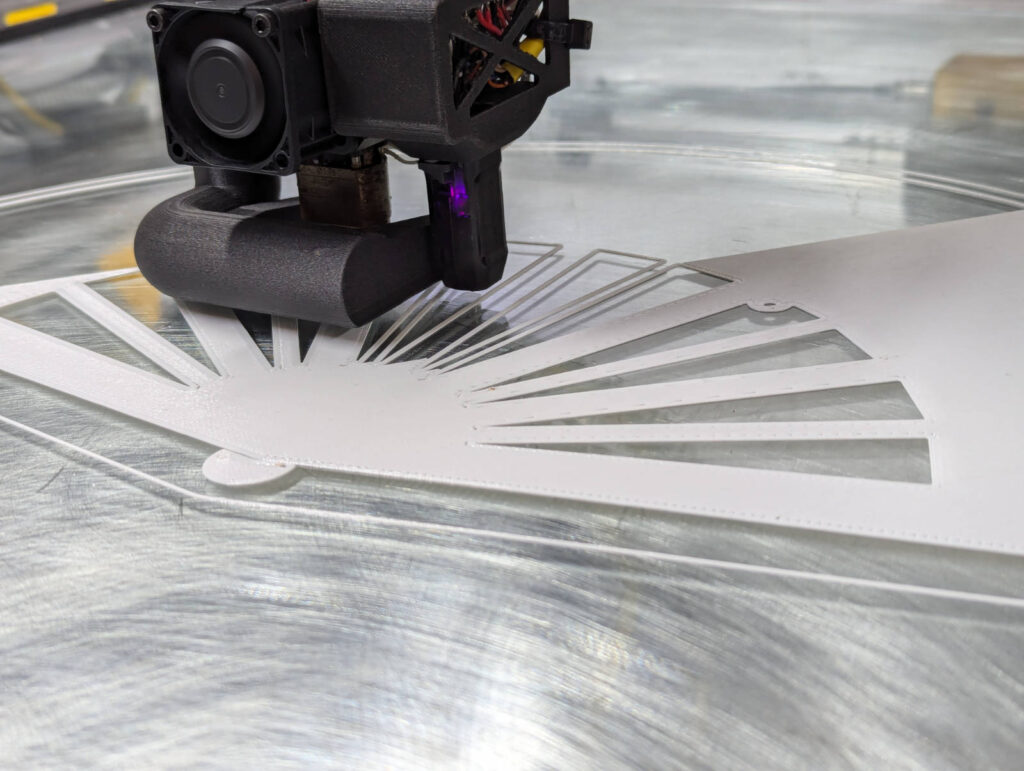
Once the designs were approved, we printed the mounts in white PLA on our large-format printer. The white material provided a smooth, consistent base for the museum’s finishing process. The prints captured every detail of the modeled surface, from the gentle curves matching the fan’s shape to the precisely located mounting hardware recesses.
After delivery, the Carnegie Museum team applied their expertise:
- Light sanding to perfect the surface
- Application of surface filler where needed
- Professional matte black finish coating to achieve exhibition-ready appearance
- Protective barrier to chemically isolate the mount from the artifact
The Outcome
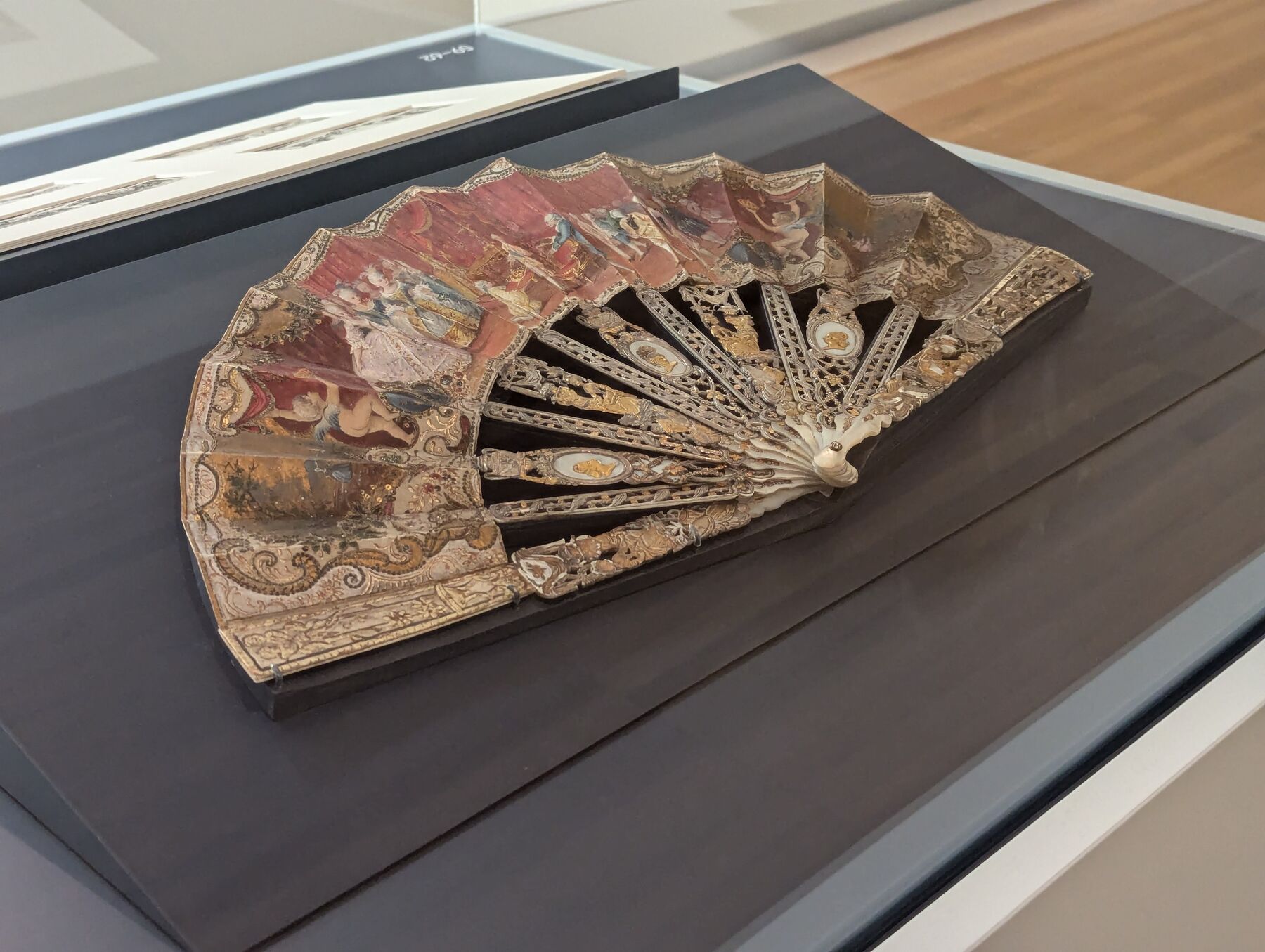
The project resulted in two successful custom mounts. The first was used in the museum’s exhibition, where it performed flawlessly – allowing visitors to appreciate the antique fan while ensuring its protection. The second mount, while no longer needed for exhibition, now serves as a specialized cradle for permanent storage, ensuring the fan remains protected for future generations.
The museum team’s response said it all:
“We were able to test fit your mount with the first fan and wanted to let you know that it worked fantastically. Thank you for your efforts on this.” – William Bergmann
Why This Matters: Full-Service Digital Fabrication
This project showcases our complete scan-to-print workflow:
Professional 3D Scanning
We capture complex geometry with sub-millimeter accuracy using our Einstar scanner – even in challenging setups.
Advanced 3D Modeling
Our Blender expertise transforms scan data into functional designs tailored to your exact specifications.
Iterative Collaboration
Digital workflows enable rapid prototyping and refinement based on expert feedback without traditional manufacturing costs.
Precision Manufacturing
Whether you need one custom piece or a hundred, 3D printing makes boutique manufacturing economically viable.
Applications Beyond Museums
While this project was for museum conservation, the same scan-to-print capabilities apply to:
- Custom display stands for collectibles and antiques
- Specialized fixtures for retail and gallery installations
- Protective cradles for delicate instruments or artwork
- Replacement parts reverse-engineered from existing components
- Conservation supports for historical preservation
Ready to Bring Your Unique Project to Life?
From museum conservation to one-of-a-kind fixtures, 3D Print Pittsburgh offers complete scan-to-print services. If you have a project that demands custom design and expert execution, we would love to collaborate with you.
3D Print Pittsburgh – Where precision meets possibility
Email: [email protected] | Phone: 412-939-5611
Project Details
- Client: Carnegie Museum of Art, Pittsburgh
- Timeline: April – June 2025
- Deliverables: Two custom display/storage mounts
- Scanning: Einstar 3D scanner with plexiglass suspension technique
- Material: White PLA base (finished by client in matte black)
- Software: Blender for 3D modeling
- Key Techniques: 3D scanning, surface shrinkwrapping, topographical matching, subdivision smoothing, integrated hardware design